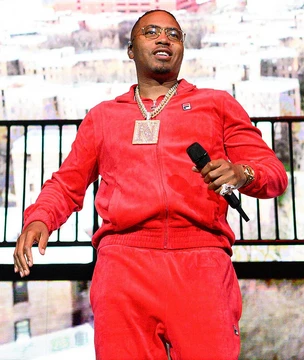
Method Man
The slowest burn in the room, and the one that takes the whole building down.

Method Man—born Clifford Smith—is the gravel-voiced, swagger-drenched founding member of Wu-Tang Clan who, in the broader Nas universe, functions as the embodiment of the gritty, cinematic, Staten Island side of 1990s New York hip-hop. Where Nas speaks in the measured, street-poetic cadence of Queensbridge, Method Man arrives like a slow-burning fuse: unhurried, dangerous, and dripping with a cool that feels almost aristocratic in its indifference.
As a Featured Artist & Collaborator in Nas's world, Method Man represents the cross-pollination that made the mid-to-late '90s New York scene feel like a single, breathing organism. Their shared era, shared city, and overlapping circles of producers, engineers, and label executives meant that the boundary between 'Nas track' and 'Wu-Tang track' was often thinner than the liner notes suggested.
- Real Name
- Clifford Smith
- Role
- Rapper, Actor, Wu-Tang Clan founding member
- Affiliation
- Wu-Tang Clan / Rucka-Ruck Records
- Scene
- New York City (Staten Island / Brooklyn)
- Acting Credits
- Jumanji (1995), Spider-Man 3 (2007) as Sandman
- Status
- Active
Lore & Background
In the mythology of 1990s New York hip-hop, Method Man occupies a singular niche: the rapper who made it look effortless to be dangerous. While Wu-Tang Clan's early records were dense, layered, and almost aggressively textural, Method Man's verses cut through that density like a blade through wet burlap. His delivery—low, unhurried, almost bored—became a signature that no one in the Nas orbit could replicate without it sounding like a cover. In the Nas universe, where every syllable is weighed and every bar is a small architectural decision, Method Man represents the counterforce: the artist who lets the silence between words do the heavy lifting.
The two men's worlds intersected most visibly in the mid-to-late '90s, when New York hip-hop was at its most interconnected. Producers like RZA, DJ Premier, and the engineers at 4th & B'way studios moved fluidly between Nas's sessions and Wu-Tang's. The result was a sonic ecosystem where a Nas hook could sit comfortably next to a Method Man bridge, and the audience in the studio would nod as if nothing unusual had happened. That casual cross-pollination—where the Queensbridge poet and the Staten Island philosopher shared a vocal chain and a cigarette break—is one of the defining textures of the era.
As a performer, Method Man brought something Nas's own catalog rarely contained in such concentrated form: a sense of theatrical menace that wasn't performative. His acting roles, from the bumbling charm of Jumanji to the genuinely unsettling Sandman in Spider-Man 3, reinforced the idea that his rap persona was the *least* exaggerated version of who he was. In the Nas universe, that makes him the ultimate collaborator: someone who elevates a track not by adding volume, but by subtracting everything that isn't essential.
In Their Own Story
The studio was on the fourth floor, the kind of place where the windows looked out onto a parking lot and the air smelled like solder and stale coffee. Nas had just laid down the last verse, stepped back from the mic, and was staring at the waveform on the monitor like it owed him money. The engineer wiped his hands on a rag and looked at the door.
Method Man walked in without knocking. He'd been in the building for twenty minutes, apparently, because he was already in a different shirt and had a paper cup of something dark balanced on his pinky finger. He didn't say hello. He set the cup on the desk, pulled up the same stool Nas used, and listened to the playback from the beginning. His eyes were half-closed. His jaw worked slowly.
When it hit the bridge—the one where the beat dropped and the strings swelled—he nodded once. Just once. Then he said, in that low, almost whispered register, "Yeah. But the second bar of your second verse. You're explaining it. You don't gotta explain it. Just… let it land."
Nas frowned. Played it back. Played it back again. Then he pulled the mic close, closed his eyes, and did it again. Slower. Quieter. Let the silence after the last word stretch out just a beat longer than comfortable.
Method Man took a sip from his cup. Nodded again. This time, a small smile.
"Okay," he said. "Now it's a track."
He left without saying goodbye. The paper cup stayed on the desk. The coffee went cold by the time the session was over, but the tape—God, the tape—still hummed.
Reader's Guide
The Nas–Method Man dynamic is less a head-to-head battle and more two different dialects of the same language. Nas builds sentences; Method Man drops single words and lets the room fill in the grammar. When they share a track, the effect is almost cinematic: Nas is the close-up, the tight lens on a face in the rain, and Method Man is the wide shot, the whole street stretching out under a sodium-vapor glow.
The era they defined together—mid-to-late '90s New York—produced records where the boundary between a Nas verse and a Wu-Tang interlude was almost invisible. You could hear RZA's production fingerprints on Nas sessions and DJ Premier's swing on Wu-Tang cuts. Method Man, sitting in the middle of that crosscurrent, brought a coolness that made Nas's urgency feel even more urgent by contrast. It's the difference between a fist hitting a wall and a slow, inevitable tide eroding the same wall.
And then there's the era's emotional anchor, the track that still makes you cringe in the best way: 'If I Ruled the World (Imagine That).' You know the one. The strings. The Maxwell hook. The way Nas's voice cracks just slightly on the final line and you swear he didn't plan it. Method Man wasn't on that record, but he was in the room, in the city, in the same sonic family. Hearing it now, years later, you can almost feel the ghost of his low murmur in the mix, the way a Wu-Tang verse would have sat right under those strings like a second heartbeat. That's the magic of the pairing: even in absence, the presence is felt. You close your eyes and you can *hear* the space where his bar would have been, and somehow that empty space is the loudest part of the track.
It's the kind of collaboration that doesn't need a shared verse to be real. It just needs the same city, the same year, and the same stubborn belief that a record should make you feel something in your sternum before it makes you feel anything in your head.
Did You Know?
- Method Man's acting career spans from the family-friendly chaos of Jumanji (1995) to the genuinely menacing Sandman in Spider-Man 3 (2007), a range that mirrors the duality of his rap persona: charming and threatening in
- Wu-Tang Clan's name derives from a Shaolin concept—'Wu' for martial, 'Tang' for the Tang Dynasty—giving the group a philosophical backbone that Method Man's unhurried delivery embodies more literally than any other membe
- In the Nas universe's mid-'90s New York scene, producers and engineers frequently moved between Nas's sessions and Wu-Tang's, meaning the sonic DNA of both camps was cross-pollinated at the mixing-board level long before
- Method Man's signature low, slow delivery became so distinctive that it influenced an entire generation of rappers who wanted to sound 'effortlessly dangerous,' a vibe that sits in direct contrast to Nas's more architect
More in Featured Artists & Collaborators
Elsewhere in the Nas universe
Spotted an error? Know more?
This is a living reference — every entry is fact-audited, and reader corrections feed straight into our audit queue. Suggest an edit · See this site's audit record