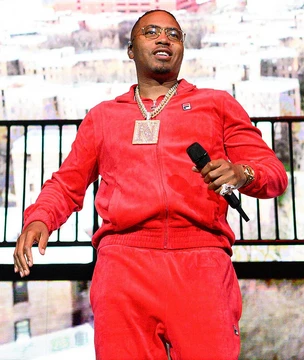
Jadakiss
The Brooklyn dreamer who turned a Nas verse into a generational anthem.

Jadakiss (Jason Phillips) is a Brooklyn rapper and producer who occupies a singular, almost mythic position in Nas's discography as the featured artist on "If I Ruled the World (Imagine That)." Originally a core member of the Bang Bang Brothers collective alongside Styles P and the late, great Big L, Jadakiss carried a melodic, streetwise cadence that sat in perfect counterpoint to Nas's dense, narrative-driven bars. In the broader Nas universe, he functions as the dreamer's voice—the one who looks up at the skyline and imagines owning it—while Nas narrates the world as it actually is.
Though his solo career produced its own body of work under the Bad Boy Records banner, it is this single, electric pairing with Nas that has cemented Jadakiss in the pantheon of hip-hop's most memorable guest verses. Fans still treat the track as a sacred text, and Jadakiss's contribution remains the emotional and melodic engine that drives the song's cinematic scope.
- Full Name
- Jason Phillips
- Origin
- Brooklyn, New York
- Collective
- Bang Bang Brothers (with Styles P and Big L)
- Label
- Bad Boy Records
- Key Nas Collaboration
- "If I Ruled the World (Imagine That)" (1998)
- Debut Solo Album
- The Family Business (1999)
Lore & Background
In the geography of late-'90s Brooklyn, the Bang Bang Brothers were a trio that moved through the borough like a single organism: Big L's razor-sharp wit, Styles P's brash swagger, and Jadakiss's smoother, more introspective flow. By the time Nas was crafting the architecture of "I Am...Nas," the collective's energy was already seeping into the surrounding scene. Jadakiss, in particular, had developed a gift for melodic storytelling that felt both intimate and expansive—qualities that made him a natural fit for a track Nas was building around the idea of a young man imagining a life beyond the block.
The collaboration was not a random studio pairing. Nas and Jadakiss shared the same borough, the same label family, and a mutual respect forged in the crucible of Brooklyn's competitive rap culture. When Nas laid down his verse—dense with internal rhyme, historical reference, and street philosophy—Jadakiss's contribution arrived like a different gear in the same machine: more lyrical in its melody, more wistful in its imagery, painting a picture of a world where the same kid who counted change at the corner store now held the keys to the city. The two verses never compete; they orbit each other.
After the Bang Bang Brothers' era wound down and Big L's tragic passing reshaped the group's identity, Jadakiss carried the torch of that collective's spirit into his solo work. "The Family Business" (1999) was, in many ways, a love letter to the brothers and the block that made them. In the Nas universe, Jadakiss endures not as a footnote but as the voice that gave the audience permission to dream alongside the narrator, rather than simply observe him.
In Their Own Story
The studio in Manhattan smelled like cold coffee and warm tape. Nas had just finished his second verse, still breathing hard, the pen capped and tossed onto the mixing desk. The engineer looked at the empty slot in the track—the bridge, the melodic lift that the beat was begging for. "Jadakiss," Nas said, not a question. The phone call was made. An hour later, Jason Phillips walked in with a hoodie pulled low, a half-smile, and a notebook full of half-formed lines about skylines and open doors. He did not need a second take. He did not need a third. When the engineer hit play on the full mix, Nas leaned back in the chair and said nothing for a long time. The room was quiet except for the hum of the monitors and the faint crackle of the vinyl spinning in the background. Then Nas said, "That's the one." And it was.
Reader's Guide
The track: "If I Ruled the World (Imagine That)" from Nas's 1998 album "I Am...Nas," also appearing on Jadakiss's 1999 debut "The Family Business."
The dynamic: Nas delivers his signature architecture—dense multisyllabic rhyme schemes, historical allusions, a narrator who observes the world with the precision of a street cartographer. Jadakiss arrives in the second half with something different: a melodic, almost singing flow that leans into the beat's piano loop and strings. Where Nas builds a fortress of syllables, Jadakiss opens a window. He is the kid on the rooftop looking at the skyline and whispering, "What if that whole thing was mine?" The contrast is the engine. Nas grounds you in the block; Jadakiss lifts you above it.
Why it was electric: The pairing works because neither artist tried to outdo the other. Nas's verse is a thesis; Jadakiss's is the emotional response. The production—layered with orchestral swells and a hypnotic groove—gives both flows room to breathe. Fans still cringe at how good it is because it feels effortless, like two friends trading stories on a stoop while the whole city hums underneath. It is the rare guest verse that does not feel like a guest. It feels like the second half of the same sentence Nas started. And twenty-five-plus years later, when that piano loop drops in, you are still that kid on the rooftop, still counting the buildings, still daring yourself to imagine you could own them all.
Did You Know?
- Jadakiss was a founding member of the Bang Bang Brothers alongside Styles P and the late Big L, a Brooklyn collective that became one of the most respected rap groups of the mid-to-late 1990s.
- "If I Ruled the World (Imagine That)" appears on both Nas's "I Am...Nas" (1998) and Jadakiss's solo debut "The Family Business" (1999), making it one of the few tracks to anchor two separate landmark albums simultaneousl
- Jadakiss is also a producer, and the melodic sensibility he brought to his rapping was informed by his experience behind the boards crafting beats for himself and fellow Brooklyn artists.
- The Bang Bang Brothers' era was defined by a tight-knit creative chemistry in Brooklyn, and Jadakiss's smoother, more introspective style served as a deliberate counterbalance to the sharper, more aggressive flows of his
More in Featured Artists & Collaborators
Elsewhere in the Nas universe
Spotted an error? Know more?
This is a living reference — every entry is fact-audited, and reader corrections feed straight into our audit queue. Suggest an edit · See this site's audit record